Regulatory Frameworks Guiding Encryption Protocols Across Austrian Casino Payment Systems and Game Providers
Nils Sullivan · Oct 21, 2026

Regulatory Frameworks Guiding Encryption Protocols Across Austrian Casino Payment Systems and Game Providers
Austrian authorities oversee encryption requirements through layered legislation that covers both payment processing and game integrity in licensed casino operations, and these rules continue to adapt as technology evolves through 2026. The core statutes include the Glücksspielgesetz along with data protection provisions that align with broader European standards, while payment systems must satisfy additional technical mandates to safeguard financial transactions.
Core Austrian Legislation on Data Security
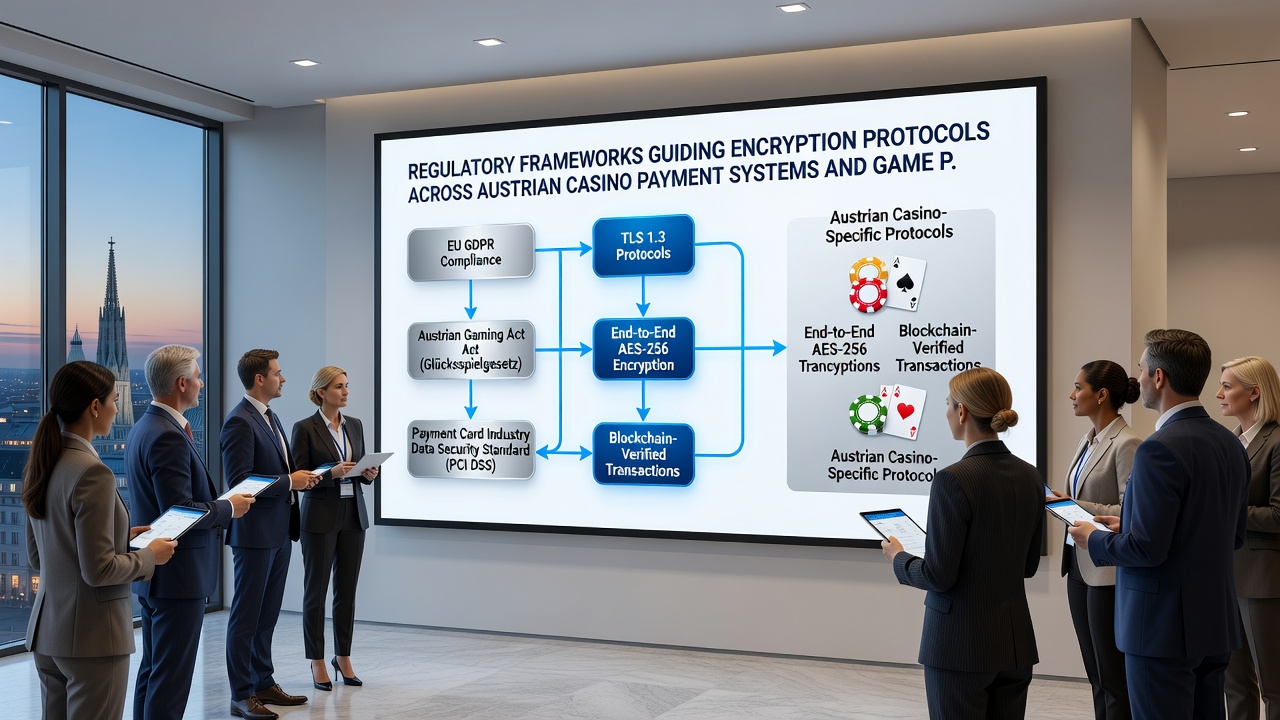
Payment systems in Austrian casinos transmit sensitive card details and account information that fall under mandatory encryption rules enforced by the Federal Ministry of Finance, and operators must implement protocols such as TLS 1.3 combined with AES-256 for all data in transit. Game providers integrate similar controls when delivering random number generator outputs and player session data, because regulators require verifiable protection against interception during real-time play. Observers note that compliance audits occur at regular intervals, and any shortfall in protocol strength triggers corrective action within specified timeframes.
Encryption Standards for Payment Processing
Casino payment gateways connect to banking networks that demand adherence to international card security benchmarks, yet Austrian rules add national verification layers that reference ENISA technical guidance on cryptographic algorithms. Operators often configure end-to-end encryption so that transaction records remain unreadable outside authorized systems, and these setups receive testing through independent laboratories before licensing renewal. Data shows that transaction volumes handled under these protocols reached substantial figures by mid-2026, reflecting consistent regulatory oversight across multiple providers.
Game providers face parallel obligations when streaming live dealer feeds or updating player balances, because the same transmission channels carry both financial and entertainment data. Regulators require documented key management procedures that include regular rotation schedules and secure storage practices, ensuring that compromised keys do not expose historical records. Those who have examined audit summaries find that most licensed entities maintain centralized logging systems that record encryption handshake details for later review.
Integration with European and International Benchmarks
Austrian frameworks reference guidelines from the European Union Agency for Cybersecurity on algorithm selection, and they also incorporate elements from standards bodies outside Europe such as those maintained by the National Institute of Standards and Technology. This cross-regional approach allows operators to align local systems with globally recognized methods while satisfying domestic inspection criteria. Casino groups that operate across borders frequently harmonize their encryption stacks to meet the strictest applicable rule set, and October 2026 saw several Austrian licensees complete such alignment projects ahead of scheduled reviews.
Payment processors must also satisfy PCI DSS requirements that specify minimum encryption strengths for cardholder data, and Austrian regulators cross-check these certifications during licensing procedures. Game providers submit evidence that their platforms use approved cipher suites when communicating with mobile applications or desktop clients, preventing downgrade attacks that could weaken protection. Research from academic sources on cryptographic implementation indicates that consistent application of these measures reduces successful breach attempts across regulated environments.
Monitoring, Audits, and Compliance Mechanisms
Regulatory bodies conduct both scheduled and surprise inspections that examine encryption configuration files, certificate validity periods, and key storage hardware. Licensees prepare detailed reports that list every protocol version in use, along with supporting documentation from third-party evaluators. Those who have reviewed public summaries of these audits observe that most deficiencies involve outdated library versions rather than fundamental design flaws, and remediation typically occurs within weeks.
October 2026 brought updated guidance from Austrian authorities on post-quantum cryptography readiness, prompting several game providers to begin testing hybrid encryption schemes that combine current algorithms with emerging lattice-based methods. Payment system vendors followed suit by evaluating similar upgrades for transaction channels, because forward secrecy remains a stated priority in regulatory circulars. Industry reports compiled by European trade associations show gradual adoption rates that vary according to platform age and vendor support cycles.
Conclusion
Encryption protocols in Austrian casino environments operate under a combination of national gambling statutes, European cybersecurity recommendations, and international payment security standards that together create a structured compliance landscape. Payment systems and game providers maintain documented controls that undergo regular verification, and ongoing developments through late 2026 reflect continued attention to algorithm strength and key management. These measures ensure that transaction data and gameplay records receive consistent protection while operators adapt to evolving technical expectations.